Showing posts with label leaves. Show all posts

Thursday, January 20, 2011

Amaryllis Blooms

What an easy grow, and what a great experience. I fed it about three nights ago along with all my other plants, and the growth sped up even more. It measures about 30 inches from the soil to the flowers. The first bloom opened three days ago, and the second bloom opened yesterday. There are two more which I expect to open either tomorrow or the day after.

It adds a great splash of color in this crappy Minnesota winter and really brightens up the whole house, along with the orchids. It's so desolate and tundra-like outside that I'd nearly forgotten how beautiful flowers are. Can't wait to have this beauty out in the garden next summer, even if it's not flowering. It can store up energy for next winter, and perhaps I'll have even more blooms. :) Well worth $6.

My mother gains much enjoyment from it as well; when I come home from college each day, she remarks on how much it's grown and how beautiful it is. She acts like she doesn't like having my plants around the house, but I know she secretly loves them... :) I just can't figure out how I'm going to move my plant family down to Minneapolis when the time comes...

Anyway, the care for this plant was extremely simple, and that's probably why it's so popular. As long as it has enough light and water, it'll do just fine. I did discover, however, that the flower stalk needed to be staked after it grew to about 20". I had to loosely tie up the leaves as well, since they had grown so long they were tipping over. Overall a very rewarding and beautiful grow.

Saturday, January 15, 2011

Amaryllis (Hippeastrum?...)

I picked this one up at (where else?) Lowe's a couple days before Christmas when their Christmas merchandise was just going on sale. I chose the traditional red (I'm a traditional girl, what can I say?). It was $6 and well worth it already. I followed the directions for planting on the package, but growth was slow for about two or three weeks despite adequate watering. Then, all of a sudden, it started growing like crazy! Here's what happened in the span of 12 days, from January 3rd to January 15th.

 The thing grows 2 inches each day! I've been measuring it. It went from 15.5 to 16.5 to 18 and now to almost 20! I had to stake it yesterday, as it was falling over. I've never grown an Amaryllis before and am so far very satisfied.

Wait just a minute. I went to trusty old Wikipedia for a little info on Amaryllis and read that "It should not be confused with Hippeastrum, a flowering bulb commonly sold in the winter months for its ability to bloom indoors." What is this about??? Apparently, I have a plant from the Hippeastrum genus. Here's the link, if you're interested in reading more:

http://en.wikipedia.org/wiki/Amaryllis

Alright, then. Hey, apparently the two plants are pretty similar. I think I'll just go on calling this Amaryllis. No one will be the wiser. Okay, moving on.

This kit came with a nice pot, "compressed planting disk," and of course, the bulb. I'll share the info it came with. I'd like to give credit to the specific brand, but I only kept the portion of the package that had directions on it. I tried to find it on Lowe's website, but apparently everybody in charge there has suffered some sort of brain injury that has incapacitated them all. They have no "Amaryllis" information whatsoever. Anyway...

"1.) Place compressed planting disk in the pot provided and add 2 cups of warm water.
2.) Fluff up mix with a fork.
3.) Place your bulb into mix, pointed end up, so the top of the bulb is 1-2 inches above the planting mix.
4.) Put the pot in a warm place.
5.) Water once a week.
6.) As soon as the bud is visable, water twice a week until flowers have faded.
7.) Blooms in 8-10 weeks.

After Care: Plant the Amaryllis bulb in the garden in May and give it some fertilizer. Take out of the garden in September and cut off the leaves. Store the bulb in a cool dry place for two months. Then pot the bulb again. This plant will grow for many years."

Just for the sake of accuracy, I read up and checked on websites and read in all my garden books as well. One of my books, The Complete Houseplant Survival Manual (hardy har) gives pretty much the same information, just with more detail and with slight variation. This book uses Hippeastrum Hortorum as the scientific name, but Amaryllis as the common name. Eh, it works. It also says to fertilize it every 10 days, and I will when I water my plants tomorrow.

Update sure to come when it blooms. :)

Thursday, January 13, 2011

Alocasia amazonica 'polly'

I LOVE this genus. I've only got amazonica, but I've seen lots of cool varieties, like Alocasia black velvet, Alocasia cuprea, and Alocasia scabriuscula, among others. "There are 78 species of Alocasia," says Wikipedia, "occurring in Tropical & Subtropical Asia to Eastern Australia and widely cultivated in Oceania and South America." (http://en.wikipedia.org/wiki/Alocasia) I also learned from this page that you can eat the stems, but that it can "numb and swell the tongue and pharynx." However, just because you can eat it doesn't mean you should. Anyway...

'Polly' in one of my favorite painted pots.
Most of my plants have rewarded me in some way, but this was by far one of the most rewarding. As with most of my plants, this was acquired on one of my obsessive trips to Lowe's last July. :) It had many glossy, medium-sized leaves, but then fervently began shedding the old and producing monstrous new ones, with the largest being around 12 inches long. It loves humidity and moist soil, and I've got it standing on a drywell since the air is extremely dry where I live. I clean its large leaves with a damp cloth when they begin to look dusty. A very rewarding grow, but the sap is poisonous to a non-lethal extent. This was of concern to me since I've got five animals. I've got it sitting on an end table, and neither of the two cats has touched it. The cooler winter temperatures have definitely slowed its growth, but I expect a stunning emergence of new leaves this spring and summer. It should look much fuller, like it did when I first bought it:

'Polly' in May 2010
 All the leaves in this picture have since been shed and replaced with those new gigantic ones. There are only four leaves now, but I'm sure this is a normal process. I watered it correctly and gave it the bright light it loves. Feeding it only seemed to speed up the process.

Number Four: Phalaenopsis 'aphrodite'

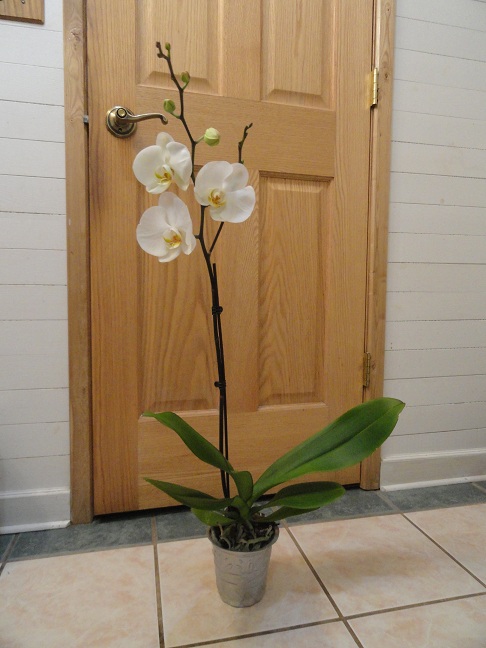
I walked into the Home Depot in a neighboring town, in search of something to mount one of my other orchids on -and let's be honest, I was curious about their plant selection. They were extremely friendly upon my entering and immediately pointed out to me that they had a new shipment of plants. They had never seen me before, so I assume that I've just taken on the appearance of a garden nut. Anyway, I noticed almost right away a HUGE cart of Phals, which I proceeded to ooh and ahh over. I told myself that A) I had no room for another Phal, B) My next orchid purchase should be another species, and C) That gigantic one with the humungous blossoms did NOT have my name on it. I drew myself away from the cart several times, but I kept coming back. On my third time back, one of the employees inquired about my fondness for the epiphytes. As soon as I realized I could converse with him about orchids, I ran my mouth up and down until I had thoroughly talked his ear off. I did, however, make an inquiry as to how the Home Depot cared for these plants. He replied that they followed the directions on the tags, giving them each 3 ice cubes every week (These plants were Just Add Ice Orchids; all of my phals have been Just Add Ice. It seems to be the only kind commonly found here). I inspected their soil and roots and was thoroughly satisfied, especially after my horror at the state of the Walmart orchids. The kindly employee also informed me that these plants had recently been marked down from $24 to $12, and I nearly fainted on the spot, what with the enormity of the plants. I knew I'd be coming back for the largest one with the huge, white flowers (after all, I didn't want to let the plant freeze in the car in the -15 weather while I ran my errands) After I had been over to various other places in town, I came back for it. They packaged it up very neatly in a brown paper bag seemingly suited for transporting orchids. I was delighted and will probably go back to the Home Depot for most of my orchid needs... :) It spent the ride home on the floor of the backseat, neatly and safely wedged in place.
At home, I thoroughly photo-documented the plant (as I do for future reference) and thought it'd be fun to take its measurements. It was the largest Phal I'd ever seen, though I'm fairly inexperienced. The flower stalk measured 34" -almost three feet! The largest leaf was 13" and the blooms were 5" across.
The bloom measures slightly less that 5" in this picture because of the curve of the petal.


I was surprised at the size of the buds as well. My thumb size is about a 6. The bud measured about an inch and a quarter.


Wednesday, January 12, 2011

Propagating African Violets

One day about a month ago, I was messing around with my plants in the windowsill when I knocked off a gorgeous, healthy leaf from one of my African Violets. I was sick about it, so I decided I would try to propagate it. I didn't have much hope at first since I'd tried to propagate a leaf from S. 'melodie' last summer without success. Add to that, there was hardly a stem to speak of on the leaf I knocked off. I stuck it in the dirt as best I could anyway, gave it a little spritz, and covered it with a plastic baggie. I placed it on the counter near (but not too near) a heater, where it could get just a little bit of light from my south window. I was surprised when it didn't rot, and even happier when I noticed recently that roots had begun to form.


After my success with this leaf, I thought it was worth a shot to propagate S. 'melodie', which hasn't been looking so good in the past couple months. I worry it might continue downhill, so perhaps it was best to take a couple of the healthiest-looking leaves to propagate. That was exactly what I did. (This propagation was before the drastic surgery I performed in removing 30 leaves).

I sterilized a paring knife with hydrogen peroxide before cleanly slicing off two leaves. They were small, as all of the big leaves are steadily fading.
I then stuck the leaves in dirt, spritzed them a tiny bit, and slid a plastic baggie over each one.
The other day, I was delighted to find that they all had rooted!