Thursday, January 13, 2011

Alocasia amazonica 'polly'

I LOVE this genus. I've only got amazonica, but I've seen lots of cool varieties, like Alocasia black velvet, Alocasia cuprea, and Alocasia scabriuscula, among others. "There are 78 species of Alocasia," says Wikipedia, "occurring in Tropical & Subtropical Asia to Eastern Australia and widely cultivated in Oceania and South America." (http://en.wikipedia.org/wiki/Alocasia) I also learned from this page that you can eat the stems, but that it can "numb and swell the tongue and pharynx." However, just because you can eat it doesn't mean you should. Anyway...

'Polly' in one of my favorite painted pots.
Most of my plants have rewarded me in some way, but this was by far one of the most rewarding. As with most of my plants, this was acquired on one of my obsessive trips to Lowe's last July. :) It had many glossy, medium-sized leaves, but then fervently began shedding the old and producing monstrous new ones, with the largest being around 12 inches long. It loves humidity and moist soil, and I've got it standing on a drywell since the air is extremely dry where I live. I clean its large leaves with a damp cloth when they begin to look dusty. A very rewarding grow, but the sap is poisonous to a non-lethal extent. This was of concern to me since I've got five animals. I've got it sitting on an end table, and neither of the two cats has touched it. The cooler winter temperatures have definitely slowed its growth, but I expect a stunning emergence of new leaves this spring and summer. It should look much fuller, like it did when I first bought it:

'Polly' in May 2010
 All the leaves in this picture have since been shed and replaced with those new gigantic ones. There are only four leaves now, but I'm sure this is a normal process. I watered it correctly and gave it the bright light it loves. Feeding it only seemed to speed up the process.

The Collection

I figured now might be a good time to introduce the family. :) Probably should have done that first, but oh, well.

I've been tending my houseplants for less than a year, but my collection has grown by leaps and bounds. I now have roughly 30 plants scattered about the house and propagate them at every turn. I've established a library of plant encyclopedias, among other books, and have made gardening (indoor and outdoor) a new passion of mine.

Starting at the leftmost plant and going up and right: Lucky Bamboo, Baby Tears, Alocasia amazonica, Christmas Cactus, Umbrella Tree, African Violet, Poinsettia, Iresine, Areca Palm, Flapjacks, Finger Jade, Silver Dollar Jade, Peperomia, Hen & Chicks, Gasteraloe, Elephant Bush, Echeveria, Phalaenopsis, Baby Tears, Red-Headed Irishman, Aeonium, Christmas Cactus, Hen & Chicks. Center: Two Phalaenopsis orchids, Ameryllis bulb, Baby Tears, Flapjacks, African Violet.


I also paint all my own pots (except for a few). Artwork has been another passion of mine throughout my life, so I thought it was great I could combine those two aspects. Gradually, I've been branching out from painting simple flowers or patterns into more complex and realistic designs.

One more thing - I would greatly appreciate any words of wisdom! I hope I've done a fairly good job in educating myself, but I also know that many of you are far more experienced.

Mounting Phalaenopsis

Let me start out by saying it was very silly of me to do this to an orchid in bloom; the only reasons I chose to do this at this point were 1) The orchid was almost done blooming, and 2) The orchid was unhealthy when I bought it, and I was willing to experiment with it. Also, this is another technique I learned from my orchid book, Orchid Growing for Wimps.
Though I'd snagged the last two orchid pots at Lowe's, I still needed one more after my purchase of 'aphrodite.' They had no more, and there was no place for me to find another unless I felt like driving an hour and a half away from hillbilly nowhere. I decided to attempt to mount one of my orchids! I bought a slim board and some sphagnum moss and headed on home. Since it was a two-hand project, I didn't thoroughly photo-document this journey. My orchid how-to book gave specific instructions, but I added a bit of my own flair. I was a little bored with just a plain plank of wood and wanted to add a bit of a decorative touch, so I painted a simple design of black vines on it. I then drilled two holes near the top of the board for the twine to go through as a hanging mechanism. I drilled on each side, going down the long side, three sets of two side-by-side holes for tying the flower stems in place. Then came the difficult part. I took one of my phals (the least healthy one from my Walmart rescue; I still wasn't sure I wouldn't kill it and wanted my loss to be fairly minimal) and removed most of the bark chips from its roots. I laid it down on the board and covered the roots with sphagnum moss, then wrapped the moss securely into place with twine, giving it the more country feel that my living room has. I used monofilament to tie the flower stalks into place, and the result was very pleasing to me. I gave the orchid a bit of a drink to wet the new potting medium only slightly. Here's hoping it doesn't croak!
This orchid will need daily spraying with a spray bottle, as it isn't in potting medium and can't be watered normally.

Number Four: Phalaenopsis 'aphrodite'

I walked into the Home Depot in a neighboring town, in search of something to mount one of my other orchids on -and let's be honest, I was curious about their plant selection. They were extremely friendly upon my entering and immediately pointed out to me that they had a new shipment of plants. They had never seen me before, so I assume that I've just taken on the appearance of a garden nut. Anyway, I noticed almost right away a HUGE cart of Phals, which I proceeded to ooh and ahh over. I told myself that A) I had no room for another Phal, B) My next orchid purchase should be another species, and C) That gigantic one with the humungous blossoms did NOT have my name on it. I drew myself away from the cart several times, but I kept coming back. On my third time back, one of the employees inquired about my fondness for the epiphytes. As soon as I realized I could converse with him about orchids, I ran my mouth up and down until I had thoroughly talked his ear off. I did, however, make an inquiry as to how the Home Depot cared for these plants. He replied that they followed the directions on the tags, giving them each 3 ice cubes every week (These plants were Just Add Ice Orchids; all of my phals have been Just Add Ice. It seems to be the only kind commonly found here). I inspected their soil and roots and was thoroughly satisfied, especially after my horror at the state of the Walmart orchids. The kindly employee also informed me that these plants had recently been marked down from $24 to $12, and I nearly fainted on the spot, what with the enormity of the plants. I knew I'd be coming back for the largest one with the huge, white flowers (after all, I didn't want to let the plant freeze in the car in the -15 weather while I ran my errands) After I had been over to various other places in town, I came back for it. They packaged it up very neatly in a brown paper bag seemingly suited for transporting orchids. I was delighted and will probably go back to the Home Depot for most of my orchid needs... :) It spent the ride home on the floor of the backseat, neatly and safely wedged in place.
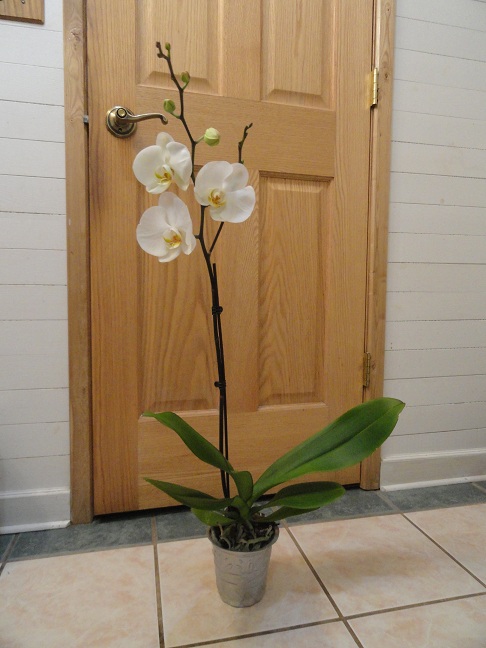
At home, I thoroughly photo-documented the plant (as I do for future reference) and thought it'd be fun to take its measurements. It was the largest Phal I'd ever seen, though I'm fairly inexperienced. The flower stalk measured 34" -almost three feet! The largest leaf was 13" and the blooms were 5" across.
The bloom measures slightly less that 5" in this picture because of the curve of the petal.


I was surprised at the size of the buds as well. My thumb size is about a 6. The bud measured about an inch and a quarter.


Wednesday, January 12, 2011

Phalaenopsis Rescue


Let me begin with something simple: DO NOT, UNDER ANY CIRCUMSTANCES, TAKE A CHANCE ON AN ORCHID FROM WALMART. Sure, Walmart's great. We all love Walmart. I love Walmart, too. Hell, they have everything. That's the problem; in trying to do everything, their wares sometimes suffer, including the poor little phals I rescued. Obviously, the person/people working in lawn and garden didn't know how to care for them; this isn't their fault. Walmart doesn't specialize in plants. And if you do choose to buy from Walmart, buy one as soon as the shipment comes in. In other words, before they have a chance to do anything potentially harmful to it.

My two phals airing out on the table.


As I mentioned in my previous entry, I purchased several plant books before making a trip to the local Walmart to check out their selection of phals. I studied up on orchids in general and started to feel more like I knew what I was doing. Where I live, there are two basic places to buy plants in winter: Walmart and Lowe's. Most of my plants have come from Lowe's, and I've found them to be of better quality than Walmart's. However, Lowe's still has its issues, like having plants infested with gnats (believe me, that was super fun to remedy). I did some research online to find orchid vendors in my area; the nearest was quite a drive away, and prices were a bit too high for my comfort. It was then that I remembered Walmart had gotten a shipment of orchids in time for Christmas, and I figured they would be on sale since the season was over. However, I knew I wouldn't be getting the cream of the crop; I wanted a challenge, though, and was willing to nurse one back to health. When I arrived, they had only 6 or 7 phals left, most of which looked pretty shoddy. I picked out the largest and healthiest-looking of the group, a specimen with white flowers speckled with magenta. It was then I spied something unusual: A smaller plant with peachy-pink colored flowers, though those flowers didn't look typical of Phalaenopsis. The petals weren't round, and the flower itself was much smaller. However, the rest of the plant looked like a phal, so I wonder if it could be some sort of hybrid (any answers would be appreciated!). Though I found this plant to be unique from the typical phal, it was obvious that something was very wrong with it; on top of the potting soil, I found 17 buds that had dropped off, and its aerial roots were shriveled at the tips. I knew from reading my book that this meant one of two things: underwatering or overwatering. Both plants were also in tiny containers which had no drainage holes or ventilation necessary for orchids. I bought both anyway at $16 each and carefully wrapped the tops with large shopping bags to carry out into the -20 degree weather! I made sure they had plenty of heat for the ride home and took them into the house immediately.

It was then that I began a more thorough inspection. After freeing them from their protective plastic, I examined the roots more closely; definitely something wrong. I felt the top of the bark chips they were planted in and discovered it was totally soaked. Panic! I carried them one by one out to the bathtub to remove them from their containers. As I carefully tilted one of them onto its side to pull it out, water came gushing from the pot. The chips were totally waterlogged, and the larger plant was unbelievably rootbound. I gingerly removed as many of the bark chips as I could before laying both plants out on the table to get a little air. I'm not sure if this would be recommended by a professional, but it seemingly worked for me. I gave them about two hours to dry out a little and get some ventilation. In that time, I went out to buy them proper orchid pots, and I was in luck since Lowe's had only two left. However, I set those pots aside once I got home to give myself an opportunity to paint them, as I love to do. :) Instead, I potted the orchids slighly loosely in normal pots with drainage holes, using standard orchid mix (bark chips). I plan to get them into their more suitable pots soon, but I don't want to keep traumatizing them with transplanting, especially in bloom. I set up a drywell on the table, cleaned their leaves, and gave them a rest for the night. This morning, I spritzed them with a little water and gave them a tiny drink as well. They seem to be doing just fine so far! 


The unique phal I picked up.

Both my phals on the kitchen table.
 
The roots of the healthiest phal.


Just some of the shriveled roots of the second phal.


Phalaenopsis (Moth Orchid)

I have become an orchid FREAK.  Unfortunately, the only species I've ever seen in good ol' rural Minnesota is Phalaenopsis. Even more unfortunate is that Walmart and Lowe's are my only choices in miles. Plus I like a bargain; in the orchid world, that may not be a good thing. :) With a little Internet research, I found several professional orchid vendors. Problem is, money's in short supply. I'm slowly easing into a new job as a figure skating coach, and I hope to take on more work at a local greenhouse this spring.

Enough of my rambling. Let's get to the good stuff.

I bought my first orchid in early May 2010 at the local Lowe's. I knew absolutely nothing about them, so I thought it best to embark on this challenge while spending only $9 on the smallest blooming one I could find, as to ensure I wouldn't have wasted my money had it died. Fortunately, it didn't! I probably owe that to my good luck of having a cashier who knew something about orchids and was willing to give me some advice. It had given me many purple-and-white blooms from two stalks, one on each tiny plant in the pot. Unfortunately, I fed it with "Orchid Food," which ended up killing off one of the two plants within 24 hours. Since then, I've been too terrified to feed it again, though I know a bit more about fertilizing it. Unwittingly, I let the remaining flower stalk fade without cutting it in hopes of another round of blooms. It grew new leaves faithfully all summer and dropped the old ones, which I now attribute to either underwatering or nature. It slowed growth this fall and completely stopped (as far as I can tell) by winter. It looks totally healthy, and I'm currently concentrating on giving it its required temperature changes in order to initiate blooming. I hope to have it in bloom again this May. It's a cute little dude, and I can't wait to see what it does.

A couple weeks ago, I stopped at a Barnes & Noble to get a good look in the gardening section. I was prepared to spend $20 or so on a good orchid book, but I ended up walking away spending $68 on all sorts of plant books... I read my orchid book (Orchid Growing for Wimps) from cover to cover in a matter of two hours. It was excellent and extremely informative. I trusted it, and learned my Phal was underwatered. I gave it a good soak, and the leaves are looking perkier already. By that time, I was on an orchid kick. I bought two more Phals the following day!
Here's a link to the book on Amazon (Hey! I paid $20 for mine!). I can't praise it enough.

Devil's Ivy (Pothos)

This is the third plant from the swap meet. My mother originally told me the Devil's Ivy was a Philodendron, but I soon discovered otherwise (though it's commonly mistaken for one). I also learned this vine is considered an invasive species in some places, and I can see why: it grows like a madman. It has a reputation for being ridiculously easy to grow; I literally ignore it except for a weekly watering. It sprouts a new leaf every week or so, and the cold weather hasn't seemed to have affected its growth at all. I'm sure it would be super easy to propagate, but I haven't tried it yet. When I first repotted it after I bought it, there were very few roots attached to what seemed to be a stem cutting that had been buried in the dirt. Perhaps I'll try it sometime. :)
The photo on the left was taken in May 2010, while the photo on the right was snapped in early January 2011. And yes, that's the same vine in both pictures. It had reached roughly 4 feet long and was getting in the way, but I couldn't bring myself to cut it off and try to root it.