Thursday, January 13, 2011

Iresine Herbstii (Bloodleaf)


May 2010

Here was another incredible transformation in a short amount of time. The photo on the right is from May or June of last year, after I first bought it. It was a cute little thing, and I barely noticed its transformation. I allowed it to grow long and lanky, despite the fact that it should be a compact, bushy plant. This was due to several reasons: weak Minnesota sunlight, lack of pruning, and rare fertilization. This plant needs a rich, nutritious potting mixture which I have not provided. However, it's grown quite tall! Over two feet high, but spindly. It needs to be staked, otherwise it falls over. I've let it get into a sad state, but have recently been inspired to take a chance on pruning it down. My fear was that it would kill the plant, but I think this one's pretty hardy. Most of my other  plants that grow so readily will easily overcome any abuse/pruning/trauma they've been through.


This plant requires fairly bright light, moist and rich soil, and lots of humidity. It's a tropical plant most often grown as an ornamentals in outside gardens. It loves to sit on a drywell and get a spray with a squirt bottle. It most certainly needs more attention from me, as you can see. It's grown probably another four inches since I took this photo! It measured 26".

January 2011

Orchid Society of Minnesota Winter Carnival 2011

I WANT TO GO SO BADLY. I started doing some research on local orchid shows, and what do you know... the closest one is 200 miles away in St. Paul. I'm up for the drive though; I'm all about road trips. :) My schedule may be a different story, though. I would need to leave sometime on Friday, as the drive takes roughly 3-4 hours, and the show opens Saturday the 29th at 10:00am. I'd also need to leave before noon, as it starts getting dark around 4, sometimes earlier, and I don't want to be driving in the dark. Problem is, I have college on Friday... but perhaps it's worth it. Yes, it is worth it. I can miss a lecture. But the weather totally determines plans; I won't be driving the highways all the way there in the middle of a snowstorm.

On a totally unrelated note, anyone out there majored or minored in horticulture? If so, what was it like? I'm considering it, among other things, after I get my AA.

But I digress. I wouldn't have to spend any money on anything but orchids and gas since my uncle conveniently lives roughly 10 minutes away from the Como Zoo and its conservatory, where the event is being held. He's a generous -but intolerant- man who I expect will welcome me with open arms. :)

Hopefully things will pan out. I've never been to one of these events and would love to buy a couple more orchids, perhaps Cattleya or Oncidium. I'd like to graduate from Phalaenopsis to something slightly more difficult.

Here are two links; one for the official Orchid Society of Minnesota and another for their Facebook page, which has many great photos from last year's carnival.
http://www.orchidsocietyofminnesota.com/
http://www.facebook.com/profile.php?id=1106585847&sk=info#!/pages/The-Orchid-Society-of-Minnesota/52958777509

Flapjacks! (Kalanchoe luciae)

 
I loved this one from the minute I laid eyes on it! I was fairly new to succulents (didn't even know what a succulent was) and had never seen a plant like this before. They had a bigger plant for $9, but I chose this cheaper $4 version.

Throughout the summer, it was a great grower and not too picky about overwatering, like some succulents are (I once had a Split Rock plant which had done well until I overwatered it just a little...) Its name suits it, and mine was and is still healthy as a horse. They're native to a much warmer climate, and have bright red rims on the edges when in the strong light they crave. However, here in the good old Midwest, the sunlight isn't bright enough for it to develop that red color; instead, the plant is almost totally green. This summer, I plan to have it outside in the bright sun to give it what it deserves.

Then, in mid-summer, I couldn't resist going back to buy the much larger Flapjacks; that, too, has done surprisingly well in this colder climate, and has grown about 12-16 inches tall.

Around September or October, I saw a tiny baby offsets growing at the bases of the plants! The smaller plant only formed one offset (which is still attached to its mother), but the large plant produced about five. I decided to remove a baby from the mother and try to propagate it. I followed directions given, and the little flapjack looked okay for a few days before it began to rot (sigh...). This spring or summer, I'm going to have another go at it when the babies are larger, stronger, and have more roots of their own.

My first flapjacks plant in January 2011

My second plant in January 2011. At its base, you can see one of the offsets.


Alocasia amazonica 'polly'

I LOVE this genus. I've only got amazonica, but I've seen lots of cool varieties, like Alocasia black velvet, Alocasia cuprea, and Alocasia scabriuscula, among others. "There are 78 species of Alocasia," says Wikipedia, "occurring in Tropical & Subtropical Asia to Eastern Australia and widely cultivated in Oceania and South America." (http://en.wikipedia.org/wiki/Alocasia) I also learned from this page that you can eat the stems, but that it can "numb and swell the tongue and pharynx." However, just because you can eat it doesn't mean you should. Anyway...

'Polly' in one of my favorite painted pots.
Most of my plants have rewarded me in some way, but this was by far one of the most rewarding. As with most of my plants, this was acquired on one of my obsessive trips to Lowe's last July. :) It had many glossy, medium-sized leaves, but then fervently began shedding the old and producing monstrous new ones, with the largest being around 12 inches long. It loves humidity and moist soil, and I've got it standing on a drywell since the air is extremely dry where I live. I clean its large leaves with a damp cloth when they begin to look dusty. A very rewarding grow, but the sap is poisonous to a non-lethal extent. This was of concern to me since I've got five animals. I've got it sitting on an end table, and neither of the two cats has touched it. The cooler winter temperatures have definitely slowed its growth, but I expect a stunning emergence of new leaves this spring and summer. It should look much fuller, like it did when I first bought it:

'Polly' in May 2010
 All the leaves in this picture have since been shed and replaced with those new gigantic ones. There are only four leaves now, but I'm sure this is a normal process. I watered it correctly and gave it the bright light it loves. Feeding it only seemed to speed up the process.

The Collection

I figured now might be a good time to introduce the family. :) Probably should have done that first, but oh, well.

I've been tending my houseplants for less than a year, but my collection has grown by leaps and bounds. I now have roughly 30 plants scattered about the house and propagate them at every turn. I've established a library of plant encyclopedias, among other books, and have made gardening (indoor and outdoor) a new passion of mine.

Starting at the leftmost plant and going up and right: Lucky Bamboo, Baby Tears, Alocasia amazonica, Christmas Cactus, Umbrella Tree, African Violet, Poinsettia, Iresine, Areca Palm, Flapjacks, Finger Jade, Silver Dollar Jade, Peperomia, Hen & Chicks, Gasteraloe, Elephant Bush, Echeveria, Phalaenopsis, Baby Tears, Red-Headed Irishman, Aeonium, Christmas Cactus, Hen & Chicks. Center: Two Phalaenopsis orchids, Ameryllis bulb, Baby Tears, Flapjacks, African Violet.


I also paint all my own pots (except for a few). Artwork has been another passion of mine throughout my life, so I thought it was great I could combine those two aspects. Gradually, I've been branching out from painting simple flowers or patterns into more complex and realistic designs.

One more thing - I would greatly appreciate any words of wisdom! I hope I've done a fairly good job in educating myself, but I also know that many of you are far more experienced.

Mounting Phalaenopsis

Let me start out by saying it was very silly of me to do this to an orchid in bloom; the only reasons I chose to do this at this point were 1) The orchid was almost done blooming, and 2) The orchid was unhealthy when I bought it, and I was willing to experiment with it. Also, this is another technique I learned from my orchid book, Orchid Growing for Wimps.
Though I'd snagged the last two orchid pots at Lowe's, I still needed one more after my purchase of 'aphrodite.' They had no more, and there was no place for me to find another unless I felt like driving an hour and a half away from hillbilly nowhere. I decided to attempt to mount one of my orchids! I bought a slim board and some sphagnum moss and headed on home. Since it was a two-hand project, I didn't thoroughly photo-document this journey. My orchid how-to book gave specific instructions, but I added a bit of my own flair. I was a little bored with just a plain plank of wood and wanted to add a bit of a decorative touch, so I painted a simple design of black vines on it. I then drilled two holes near the top of the board for the twine to go through as a hanging mechanism. I drilled on each side, going down the long side, three sets of two side-by-side holes for tying the flower stems in place. Then came the difficult part. I took one of my phals (the least healthy one from my Walmart rescue; I still wasn't sure I wouldn't kill it and wanted my loss to be fairly minimal) and removed most of the bark chips from its roots. I laid it down on the board and covered the roots with sphagnum moss, then wrapped the moss securely into place with twine, giving it the more country feel that my living room has. I used monofilament to tie the flower stalks into place, and the result was very pleasing to me. I gave the orchid a bit of a drink to wet the new potting medium only slightly. Here's hoping it doesn't croak!
This orchid will need daily spraying with a spray bottle, as it isn't in potting medium and can't be watered normally.

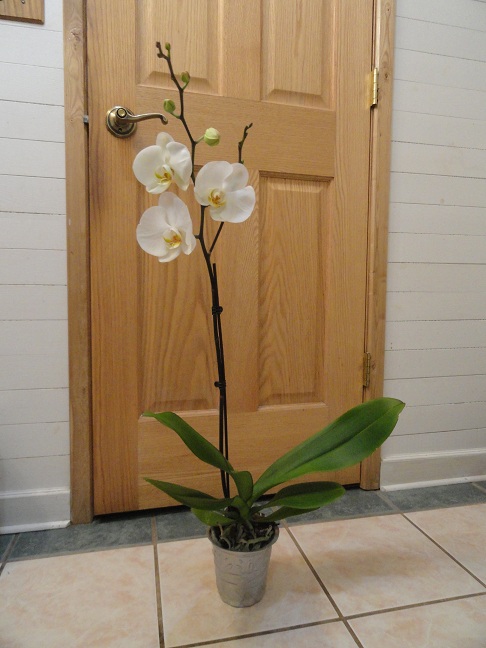
Number Four: Phalaenopsis 'aphrodite'

I walked into the Home Depot in a neighboring town, in search of something to mount one of my other orchids on -and let's be honest, I was curious about their plant selection. They were extremely friendly upon my entering and immediately pointed out to me that they had a new shipment of plants. They had never seen me before, so I assume that I've just taken on the appearance of a garden nut. Anyway, I noticed almost right away a HUGE cart of Phals, which I proceeded to ooh and ahh over. I told myself that A) I had no room for another Phal, B) My next orchid purchase should be another species, and C) That gigantic one with the humungous blossoms did NOT have my name on it. I drew myself away from the cart several times, but I kept coming back. On my third time back, one of the employees inquired about my fondness for the epiphytes. As soon as I realized I could converse with him about orchids, I ran my mouth up and down until I had thoroughly talked his ear off. I did, however, make an inquiry as to how the Home Depot cared for these plants. He replied that they followed the directions on the tags, giving them each 3 ice cubes every week (These plants were Just Add Ice Orchids; all of my phals have been Just Add Ice. It seems to be the only kind commonly found here). I inspected their soil and roots and was thoroughly satisfied, especially after my horror at the state of the Walmart orchids. The kindly employee also informed me that these plants had recently been marked down from $24 to $12, and I nearly fainted on the spot, what with the enormity of the plants. I knew I'd be coming back for the largest one with the huge, white flowers (after all, I didn't want to let the plant freeze in the car in the -15 weather while I ran my errands) After I had been over to various other places in town, I came back for it. They packaged it up very neatly in a brown paper bag seemingly suited for transporting orchids. I was delighted and will probably go back to the Home Depot for most of my orchid needs... :) It spent the ride home on the floor of the backseat, neatly and safely wedged in place.
At home, I thoroughly photo-documented the plant (as I do for future reference) and thought it'd be fun to take its measurements. It was the largest Phal I'd ever seen, though I'm fairly inexperienced. The flower stalk measured 34" -almost three feet! The largest leaf was 13" and the blooms were 5" across.
The bloom measures slightly less that 5" in this picture because of the curve of the petal.


I was surprised at the size of the buds as well. My thumb size is about a 6. The bud measured about an inch and a quarter.